
Have you ever stood in the middle of your living room—surrounded by the comfortable furniture you picked out, the smart TV you researched for weeks, and the piles of gadgets that were supposed to save you time—and felt… heavy?
Not physically heavy, but a strange, spiritual gravity pulling on your chest.
This is a peculiar modern condition. We are the most comfortable humans to ever walk the earth. We have climate control, infinite entertainment in our pockets, and food delivered to our doorsteps by strangers. Yet, for many of us, there is a persistent, low-level hum of anxiety. A feeling that we are running a race we did not sign up for, chasing a finish line that keeps moving. We are drowning in stuff, yet starving for meaning. We are busy, but not fulfilled. Connected, but lonely.
This is not an accident. It is the result of a script we have been reading from since birth—a script that fills our lives while quietly emptying us.
The Factory Settings
Let us talk about your Factory Settings.
When you buy a new computer, it comes pre-loaded with software. Some of it is useful, but a lot of it is “bloatware”—programs you did not ask for, that slow down the system and pester you with notifications. Humans are the same. We are born into a world that installs a default operating system into our brains before we can even speak.
The script goes like this:
- Go to school.
- Get good grades so you can get into a good college.
- Get a degree so you can get a safe, high-paying job.
- Use the money from that job to buy a car, a house, and nice clothes.
- Find a partner who is also following the script.
- Have children and install the script on them.
- Work hard for 40 years, upgrading your stuff along the way.
- Retire, and finally—finally—be happy.
This is the the “Standard Life Path.” For a long time, it seemed to work. It provided safety, stability, and material comfort. But there is a bug in the code. The script assumes that happiness is a destination you arrive at after acquiring enough things. It assumes that the purpose of life is the accumulation of resources.
What happens when you follow the script perfectly, you get the job, the car, the house, and the big TV… and you still feel that heaviness? You feel betrayed. You think, “I did everything right. Why is this not working?”
The problem is not that you failed at the script. The problem is the script itself. It was designed for a world of scarcity, where survival was the main goal. But we now live in a world of relative abundance. Our Factory Settings are optimizing for a problem we solved a hundred years ago. We are trying to fill a spiritual hole with physical goods, and it is like trying to solve a math problem by chewing gum. It does not work.
Minimalism begins the moment you question this script.
The Dopamine Donkey
To keep us running on this treadmill, our brains employ a very specific character. Let us call him the Dopamine Donkey.
The Dopamine Donkey lives in the limbic system of your brain. He is simple, energetic, and easily distracted. His entire purpose in life is to chase the Carrot.
The Carrot is “The Next Thing.”
It starts small. A new toy. A video game. Then it grows. The new phone. The designer shoes. The promotion. The luxury car. The bigger house.
The Donkey believes, with every fibre of his being, that if he just catches the Carrot, he will be eternally happy. He whispers to you:
“Look at that sleek new laptop. If you had that, you would be so productive. You would finally write that novel. You would be the kind of person who has it together. Just buy it. It is only $1200. You deserve it.”
So you work hard. You save up. You swipe the card.
For a moment—a brief, shining moment—you catch the Carrot.
The dopamine hits. You feel a rush of excitement as you unbox the item. The smell of new electronics. The shine of the metal. You feel complete. You feel successful.
Then something tragic happens. You take a bite of the Carrot. It tastes good for a minute. Then it is gone. The new car smell fades. The phone gets a scratch. The house becomes “the place where I do laundry.” The magic evaporates.
The Dopamine Donkey looks up, confused. The happiness did not last. He looks around and spots a new, shinier Carrot in the distance.
“Oh, wait!” he says. “That was not the real Carrot. That one over there—the Tesla, the vacation home, the promotion to VP—that is the one that will fix everything.”
And so, you start running again.
This cycle is the engine of our consumer economy. It relies on the biological fact that our brains are wired to seek reward, not to be content with it. We are designed to want, not to have. The Dopamine Donkey is a survival mechanism gone rogue in a department store. He keeps us working long hours to buy things we do not need, to impress people we do not like, in hopes of feeling a satisfaction that never arrives.
Minimalism does not kill the Dopamine Donkey. It simply takes the Carrot out of the hands of advertisers and puts it back into yours.
The Social Survival Mammoth
The Donkey is not working alone. He has a partner in crime: The Social Survival Mammoth.
The Mammoth is the ancient, hairy beast in your brain that cares deeply about what the tribe thinks of you. Fifty thousand years ago, being rejected by the tribe meant death. If you did not fit in, you were left alone in the cold to be eaten by a saber-toothed tiger. So, we evolved a hypersensitivity to social status.
Today, there are no tigers. But the Mammoth does not know that.
When you see your neighbour pull up in a brand new SUV, the Mammoth panics.
“They have resources!” he screams. “They are higher status! We are falling behind! If we do not get a better car, the tribe will reject us and we will die alone!”
It sounds ridiculous when you say it out loud. But that knot of anxiety you feel when you wear an old outfit to a fancy party? That is the Mammoth. The shame you feel about driving a beat-up car? That is the Mammoth.
We buy things not just for their utility, but as signal flares to the tribe. “Look at my watch! Look at my kitchen renovation! I am successful! I am valuable! Please do not exile me!”
We end up spending money we do not have, to buy things we do not need, to impress people who do not care. We build a prison of debt and clutter to keep the Mammoth calm.
Minimalism is not about pretending status does not exist. It is about choosing a different status game. Instead of “Who has the most?” the question becomes, “Who is the most free?” “Who is the most present?” “Who carries the lightest backpack?”
The Someday Slug
While the Donkey runs and the Mammoth panics, a third character quietly ruins your life in the background: The Someday Slug.
The Someday Slug is the master of procrastination—not the “I will do my homework later” kind, but the existential kind.
The Slug convinces you that your real life has not started yet. It is always just around the corner.
“I will be happy someday,” the Slug says. “Someday, when I get the promotion. Someday, when I pay off the mortgage. Someday, when the kids are grown. Someday, when I lose 20 pounds.”
The Slug turns your life into a waiting room. You are constantly preparing to live, but never actually living. You endure a job you hate because “someday” it will pay off. You fill your garage with boxes of stuff you might need “someday.” You delay your passions, your travels, your joy, all for a mythical future date that never appears on the calendar.
The tragedy is that while you are waiting for Someday, Today is slipping through your fingers like sand.
Minimalism is a direct attack on the Someday Slug. It is the decision to stop postponing a meaningful life until your possessions and circumstances reach some imaginary perfection. It is the quiet rebellion of saying, “This is my life. I will live it now, with less.”
The Turning Point: What Is Minimalism?
So, we have the Donkey running us ragged, the Mammoth terrifying us into conformity, and the Slug stealing our present moment. The result is a life that looks perfect on the outside but feels hollow on the inside. We are weighed down by the physical clutter in our homes and the mental clutter in our heads.
This is where Minimalism comes in.
Minimalism is widely misunderstood. It is not about living in a white room with one chair and a cactus. It is not about counting your items and making sure you own less than 100 things. It is not a cult of deprivation.
Minimalism is a tool.
Imagine your life is a backpack. Right now, it is stuffed to the brim. It is heavy. Your shoulders ache. You can barely move. Inside, there are some things you truly need—water, a map, a warm jacket. But mostly, it is filled with rocks. Rocks labelled “Social Expectations,” “Debt,” “Clutter,” “Toxic Relationships,” “Busywork,” and “Other People’s Opinions.”
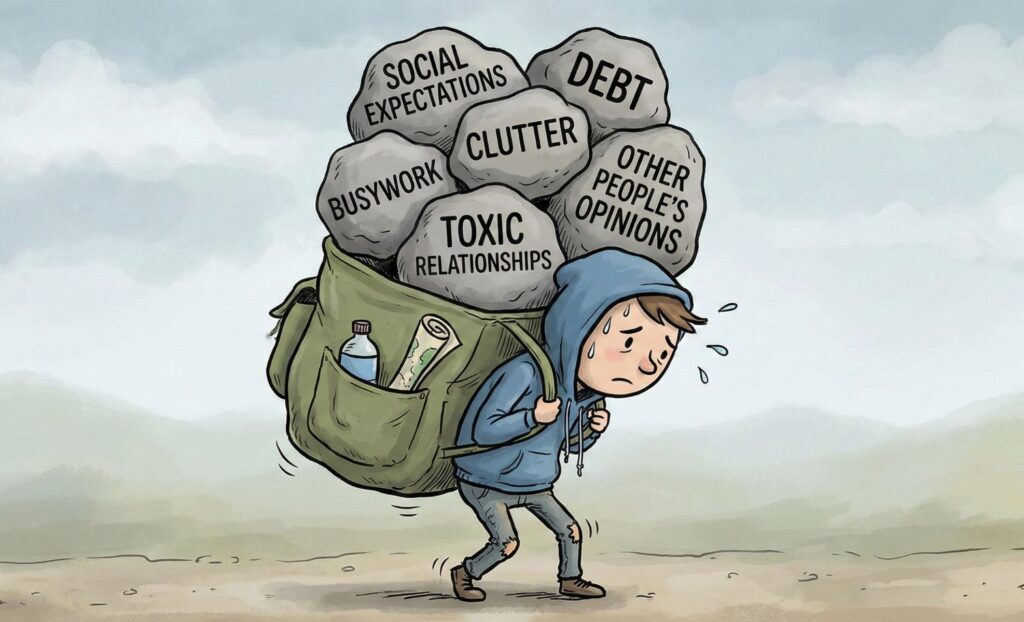
Minimalism is simply the act of taking the backpack off, turning it upside down, and dumping everything out on the floor.
Then, you pick up each item and ask a simple question: “Does this add value to my life?”
If the answer is yes, it goes back in the bag.
If the answer is no, it stays on the floor.
When you put the backpack on again, it is light. You can run. You can dance. You can climb mountains.
Minimalism is the intentional promotion of the things we most value and the removal of everything that distracts us from them. It is not about less for the sake of less; it is about less for the sake of more of what matters.
Minimalism is how you make space to finally see your Life Compass.
The Life Compass
Your Life Compass is that quiet inner voice that knows what you actually care about. It has been drowned out for years by the screaming of the Donkey and the Mammoth and the low, sleepy murmur of the Slug.
When you clear the clutter—the physical junk, the time-wasting obligations, the toxic relationships—the noise dies down. In the silence, you can finally hear the Compass.
It points towards five key areas. The authors of Minimalism: Live a Meaningful Life, Joshua Fields Millburn and Ryan Nicodemus, identify these as the five values of a meaningful life:
- Health
- Relationships
- Passion
- Growth
- Contribution
Minimalism is not the goal in any of these areas. It is the clearing of space so that these five can take centre stage.
Let us take a deep dive into each one, and see how shedding the excess weight allows us to flourish.
1. Health: The Foundation
Without health, nothing else matters. It is the platform upon which your entire life is built. Yet, health is often the first thing we sacrifice. We trade sleep for productivity. We trade home-cooked meals for fast food because we are “too busy.” We trade movement for sitting in office chairs to earn money to buy things to impress the Mammoth.
Minimalism asks: “What if you stopped trading?”
When you stop chasing the Dopamine Donkey, you reclaim your time. You have time to cook. You have time to walk. You have time to sleep.
It is not only about the physical body. It is also about mental health. The stress of debt, the anxiety of clutter, the pressure of status—these are toxins. They raise your cortisol, disrupt your sleep, and shorten your life.
Minimalism is a health intervention. By removing the stressors of consumerism, you are literally saving your own life. You are telling the Someday Slug, “No, I will not get healthy ‘someday.’ I will prioritise my vessel today.”
2. Relationships: The True Wealth
If you look at the happiest people on earth, they do not have the most stuff. They have the strongest relationships.
But relationships take time and energy. When your backpack is full of rocks, you have no energy left for people.
How many times have you been too tired after work to play with your children? How many times have you checked your phone during a dinner with your partner because you were “busy”? How many friendships have faded because you were too focused on the rat race?
The Mammoth tells us that people will like us if we are successful—if we have the big house and the fancy job. But that is a lie. People like us for our presence, our kindness, and our vulnerability.
Minimalism clears the calendar. It says “no” to the obligatory networking events and the shallow social climbing, so you can say “yes” to deep, meaningful connections. It allows you to stop trying to impress people and start connecting with them.
It also means decluttering toxic relationships. Just as you throw out the broken toaster, you can let go of the “friends” who drain your energy, criticise your dreams, or only call when they need something. You curate your social circle with the same intention with which you curate your closet.
3. Passion: The Fire Inside
Everyone has a fire inside them. A creative spark. A curiosity. A desire to build, write, paint, solve, or explore.
For many of us, that fire has been smothered by the wet blanket of “responsibility.”
The Factory Settings tell us: “Follow your passion? That is cute. But be realistic. Get a real job. Pay the bills. You can paint on the weekends.”
But the weekends are filled with errands, cleaning the big house, and recovering from the work week. So the painting never happens. The Someday Slug whispers, “Wait until retirement.”
Minimalism flips the script. It asks: “What if I did not need so much money?”
If you did not have the car payment, the credit card debt, and the mortgage on the house with the three empty guest rooms, how much would you actually need to earn?
Maybe you could work less. Maybe you could take a lower-paying job that you actually enjoy. Maybe you could finally write that book.
Minimalism buys you freedom. It buys you the mental space to rediscover what you love. It turns “I have to” into “I get to.” It allows you to pursue passion not as a hobby, but as a way of life.
4. Growth: The Infinite Game
The Someday Slug loves comfort. He wants you to sit on the couch and watch television.
But humans are not designed for endless comfort. We are designed for growth. We are designed to learn, to adapt, to overcome challenges.
When you stop growing, you start dying.
Minimalism removes the distractions that keep you stagnant. When you are not spending your weekends shopping or organising your garage, you have time to learn a new language, to take a class, to get in shape, to read.
Growth does not mean “career advancement.” It means becoming a better version of yourself. It means upgrading your internal operating system instead of just upgrading your phone.
It is the satisfaction of going to bed a little bit wiser, stronger, or kinder than you were when you woke up.
5. Contribution: The Secret to Happiness
Here is the ultimate secret, the one the Donkey will never understand: Living for yourself is boring.
You can buy all the things, travel to all the places, and have the perfect body, but if you are not contributing to something bigger than yourself, you will still feel that hollowness.
Contribution is the antidote to the ego. It is the act of giving back.
When you are drowning in your own problems—your debt, your clutter, your status anxiety—you do not have the bandwidth to help others. You are in survival mode.
Minimalism frees you from survival mode.
When you have excess time and money (because you are not buying distractions), you can give it away. You can volunteer. You can mentor. You can support causes you believe in.
Something strange happens. When you help others, the Mammoth calms down. The Donkey goes to sleep. You feel a deep, resonant sense of purpose. You realise that you are not just a consumer; you are a citizen. You are a neighbour. You are a human being with something to give.
Minimalism redirects the energy you once spent acquiring more towards contributing more.
Conclusion: The Gentle Invitation
So, here we are. Standing in the living room. The backpack is heavy.
You have a choice.
You can keep reading the script. You can keep listening to the Donkey and the Mammoth. You can keep waiting for the Someday Slug to give you permission to live.
Or you can put the backpack down.
You do not have to become a monk. You do not have to sell everything you own tomorrow.
Just start with one thing.
One drawer. One commitment. One toxic belief.
Ask yourself: “Does this add value?”
If not, let it go.
It is scary at first. The Mammoth will scream. The Donkey will cry. The Slug will complain that you are ruining his careful plans for Someday.
But then, you will feel it: a lightness. A breath of fresh air. A quiet moment of clarity where you can finally hear your own heartbeat.
That is the beginning of freedom.
That is the beginning of a meaningful life.
Minimalism is not about owning less.
It is about carrying less so you can live more.
Welcome to the other side.

Happy is a Machine Learning Engineer whose academic journey spans a Ph.D. from IIT Kharagpur and postdoctoral research in France. While his professional work focuses on building intelligent systems, his deeper interest lies in philosophy and the timeless question of how to live well. Engaging with ideas from ethics, psychology, and human experience, he explores what a meaningful, balanced, and flourishing life might look like in an age shaped by technology.
This blog favors deep reflection over rote knowledge, emphasizing wisdom over quick fixes. Primarily LLM-crafted yet meticulously curated, it aligns with human thriving and mindful living. Dive in for revelations, spark your wonder, and ponder your path amid today's trials and age-old truths.